

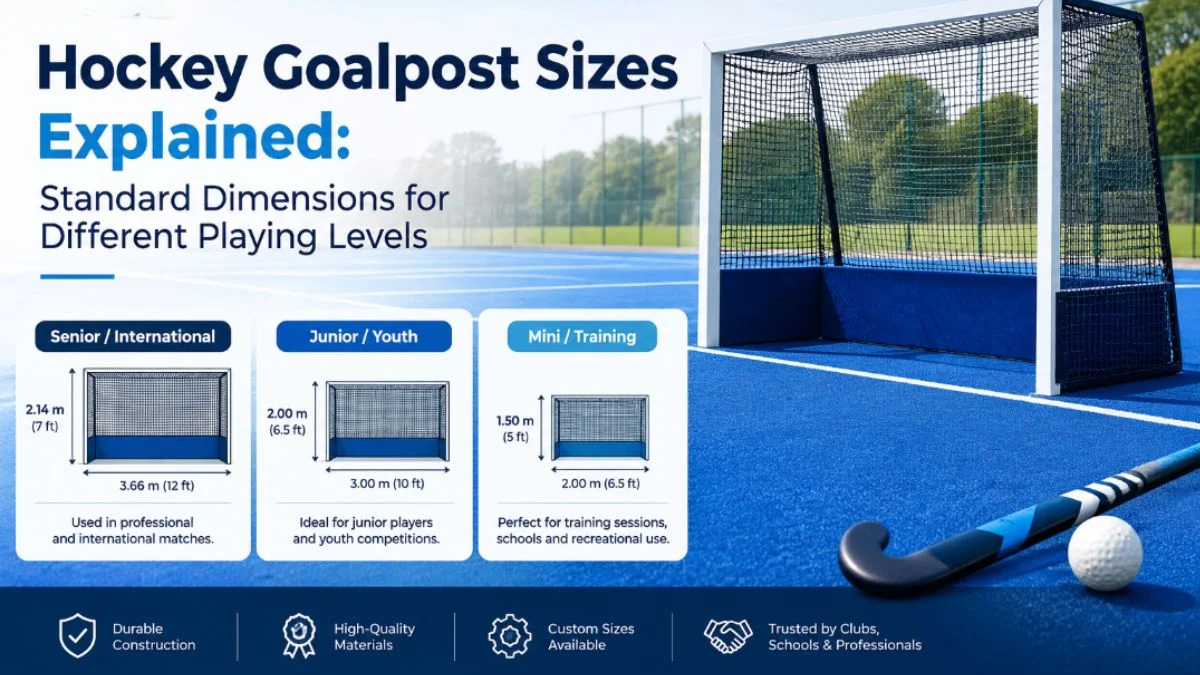
While the hockey goalpost might seem like any other sports, its dimensions play a critical role. They affect how the goalposts fit into the playing field and how the matches are played.
In case you are installing an official hockey ground, a school ground, or a training facility, selecting the right goalpost size is vital. However, do hockey goalposts have different dimensions depending on age categories? What is the standard size in international hockey? Also, what are the differences between a full-size goalpost and a junior training goalpost?
Here is an easy guide to hockey goalpost dimensions and factors to consider before purchasing the.
What Are the Dimensions of a Standard Hockey Goalpost?
The standard outdoor goalpost size for field hockey is 3.66 m in width and 2.14 m This is especially relevant if the goalpost is used for regulated competitions.
The Relevance of Goalpost Dimension Measurements
Imagine playing on the pitch with proper markings, but the goalpost is several centimetres shorter than it is supposed to be. This may not seem like an important matter, but at the competitive level, small changes can affect the game process.
Correct measurements provide:
- Uniform playing conditions
- Proper goal scoring
- Normal ball rebounding behaviour
- Correct net placement
- Conformity with the competition standards
- Better mobility near the goal area
It is not always necessary to have competition-sized goals at school and training grounds. However, using the right size goalpost will allow players to get accustomed to the equipment they will later see in competitions.
Hockey Goals for Senior Players
Full-size goals measuring 3.66 m × 2.14 m are used for senior and international field hockey.
These goals are designed for high-intensity use and are normally manufactured with sturdy steel or aluminium frames. The construction needs to withstand repeated impacts from hockey balls, particularly during penalty corners and powerful shots.
For competitive installations, buyers should also consider the quality of welding, surface treatment, anchoring system and net support structure. A goalpost is not simply about getting the dimensions right; it also needs to remain stable during regular use.
Goals for Junior and School-Level Hockey
The junior level of hockey does not necessarily need a universal goal dimension, unlike the senior international levels. Different academies, schools and coaching centers may have different sizes for goals depending on the age groups and the format of play.
Smaller goals can be convenient when the players are younger and also during skill development, without necessarily competing.
Before buying junior goals, it is important to look at the specific regulations of the specific school league, academy or coaching center that you wish to join, since different sizes are required according to different formats of play.
Training Goals and Practice Equipment
Training goals are usually more flexible compared to competition goals since they are required during practices. Smaller goals are often employed during practices for exercises such as shooting and passing.
Training goals can also be portable, so that a coach can place them in different areas of the field to conduct shooting drills, passing exercises, and small-sided practice matches.
Materials for Construction of Hockey Goalposts
The frame construction material defines the durability, weight and estimated lifetime of the goalposts.
Steel is mostly preferred in durable structures due to its strength and durability. In addition, it can be appropriate for school, club and permanent outdoor facilities when appropriately coated to prevent corrosion.
Aluminum is the other choice. It is a good choice in case the goals require constant moving and storage.
Finish is equally important. Properly treated against corrosion since the goals will be exposed to rain, moisture, dust and sunlight.
How to Choose the Right Goalpost
First of all, consider how the goalpost will be used. A competition goalpost should meet the regulations for the particular game. On the other hand, a school or training center might have much more leeway.
Take into account the following considerations when placing an order:
- Level of the play: Senior, junior, school or training use.
- Goalpost size: Verify width, height and depth.
- Material: Decide between steel or aluminum depending on usage.
- Netting: Check the quality of the net and its attachment system.
- Security: Make sure the goalpost can be safely fixed.
- Surface: Choose the finish appropriate for the location.
- Portability: Take into account if there is a need for constant moving of the goalpost.
- Replacement: Find out if the goalpost replacement parts and nets are easily available.
Cooperating with the seasoned Hockey Goal post Manufacturers like Metco Sports Global can help you choose the equipment for your particular use.
Frequently Asked Questions
Standard goal posts for field hockey measure 3.66 metres wide and 2.14 metres high.
They are not always the same. There are specific dimensions for senior hockey games but for junior training and youth hockey, goals can be different.
It is usually 3 metres wide and 2 metres high.
Steel would be the best material for your goal post but you can go for aluminium when you want something light.
Goal posts come in different depths at the top and the bottom. A typical full-size goal for outdoor use is around 1.2 meters deep at the top and about 2.1 metres deep at